
Family-owned paving & masonry contractor serving New Jersey for 30+ years · Licensed & insured
Serving Branchburg & Somerset County
Asphalt, pavers and concrete for driveways, patios, walkways and parking areas in Branchburg, NJ, built on a properly compacted base.
Three decades paving NJ properties
Fully licensed NJ contractor
Owner-led, hands-on projects
Written, no-obligation quotes
Branchburg, NJ
Quick answer
Old Irish Paving & Masonry provides paving services in Branchburg, NJ, including asphalt and blacktop driveways, interlocking pavers, concrete, patios, walkways and parking lots, plus repairs and sealcoating. We’re family-owned, licensed and insured, with 30+ years of experience in Somerset County.
Branchburg has 1970s–2000s colonials and split-levels on good-sized lots, plus farms and the historic villages of North Branch and Neshanic Station. Whatever you’re paving in Branchburg, the result depends on what’s underneath: excavation to stable ground, a compacted stone base, and drainage that moves water away from your home.
Gently rolling land near the North and South Branches of the Raritan River can hold water, so grading and base depth matter.
Key facts
Problems we solve
These are the issues we’re called about most in Branchburg and nearby Somerset County: some are specific to local soils, terrain and housing, others are common across New Jersey.
What you seeFamilies outgrowing original two-car drives.
Why it happens1970s–90s layouts.
How we fix itWidening, parking pads and Belgian block borders.
How to prevent itCheck township rules before widening.
What you seeSoggy edges, standing water and patios that settle.
Why it happensLow-lying land near the North and South Branches of the Raritan.
How we fix itDeeper base, fabric and drainage improvements.
How to prevent itMaintain grading and gutters.
What you seeTruck-route potholes, faded striping and ponding.
Why it happensHeavy truck traffic.
How we fix itFull-depth patching, thicker sections, overlays and striping.
How to prevent itScheduled maintenance plans.
What you seeA patch of interconnected cracks that looks like reptile skin, usually in wheel paths or near the garage.
Why it happensThe base underneath has failed. Water got through surface cracks, softened the stone and soil, and the asphalt is now flexing under every car. It’s a structural failure, not a surface one.
How we fix itWe saw-cut around the failed area, dig out the asphalt and the wet base, install and compact new stone, then patch with hot-mix asphalt. If more than about a quarter of the driveway looks like this, full replacement is the better value.
How to prevent itSeal cracks as soon as they appear, keep downspouts discharging away from the driveway, and sealcoat every 2–3 years.
What you seeSections of pavers have lifted, often near the house or where water collects.
Why it happensWater in a poorly draining base freezing and expanding. Frost-susceptible soils make it worse.
How we fix itWe rebuild the base with free-draining stone, correct the pitch and address the water source (downspouts, grading).
How to prevent itProper base material and drainage prevent heaving. This is the most important detail on any paver job.
What you seeThe top layer of concrete is peeling off in flakes or patches.
Why it happensFreeze-thaw cycles combined with de-icing salts, especially on concrete without air entrainment, or concrete that was overworked or finished with water on top.
How we fix itSmall areas can be resurfaced. Widespread scaling means replacement with air-entrained concrete, proper finishing and curing, then sealing.
How to prevent itNo rock salt or ammonium de-icers in the first winter, and seal every few years.
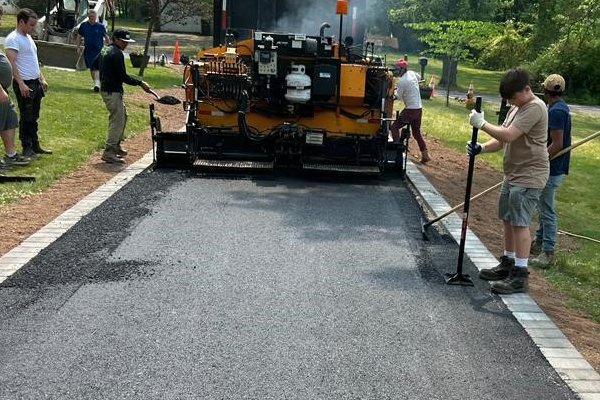
Branchburg homeowners often widen original driveways, add parking pads for extra cars and finish with Belgian block curbs or paver aprons.
We pave homes throughout Branchburg and serve office and industrial properties along the Route 202/22 corridor.
Every Branchburg quote lists the excavation depth, base depth and finished thickness in writing so you can compare contractors fairly.
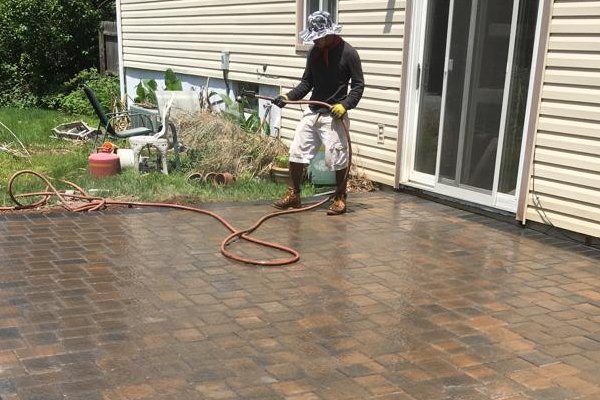
Compare them in our guide: asphalt vs. concrete vs. pavers.
Office parks and industrial properties along Routes 22 and 202 rely on us for lot resurfacing, repairs and striping. For homeowners, see residential paving, and for businesses see commercial paving.
Plan with confidence
Reviews
★★★★★
We just had our driveway and front walkway paved and outlined in Belgian block by Old Irish. The company handled the project with very good expertise and experience. The crew was hardworking and went the extra mile, ensuring we were satisfied with the project details from start to finish.
— James M., Google review
★★★★★
I met with the owner Thomas, who gave me ideas and choices for the look I was trying to envision. The crew tore up my old cracked concrete patio and sidewalk and installed gorgeous new pavers. They did the work promptly and professionally and cleaned up well after the jobsite.
— Dawn G., Google review
★★★★★
Last month they did my backyard stoop, patio and walkway, and added a french drain to a sump pit in the yard. They did an amazing job! I highly recommend them for any paving and masonry work. Tom and crew are a pleasure to deal with.
— Bill P., Google review
FAQ
It depends on size, the condition of the existing surface, how much excavation and base is needed, access and the material. We give free written quotes after a short site visit.
Yes. We pave driveways, patios and walkways for Branchburg homeowners and parking lots and access drives for local businesses.
Yes. We work throughout Branchburg Township, including North Branch and Neshanic Station, and in neighboring Bridgewater, Somerville and Readington.
Spring through late fall, when asphalt plants are open and ground temperatures are above roughly 40–50°F. Book early, because spring and fall fill up quickly.
Usually a thin or poorly compacted base, or water undermining it. The fix is to lift the pavers, rebuild the base in compacted lifts and reset them.
Clean the joints and refill with polymeric sand, which hardens when misted. Keep joints topped up and swept.
Free, no-obligation quote
Tell us about your driveway, patio, steps or masonry project. Tom or a member of the family will call you back promptly to book a free on-site visit and a written quote.
Prefer to talk? (908) 992-2345