
Family-owned paving & masonry contractor serving New Jersey for 30+ years · Licensed & insured
New Jersey paving & masonry contractor
Interior drainage, sump pumps, exterior waterproofing, crack repair and grading corrections that stop water at the source.
Three decades paving NJ properties
Fully licensed NJ contractor
Owner-led, hands-on projects
Written, no-obligation quotes
Overview
Quick answer
Basement water in New Jersey usually comes from hydrostatic pressure in saturated clay soil, foundation cracks, failed or missing drainage, or surface water running toward the house. Old Irish Paving & Masonry finds the source and fixes it with the right combination of crack repair, interior perimeter drainage and sump pumps, exterior excavation and membranes, and grading and downspout corrections.
A damp basement is more than an inconvenience. It brings musty odors, mold, damaged belongings and lost living space, and over time water pressure can damage the foundation itself. Many New Jersey homes sit on clay soils and high water tables, and heavy storms have made wet basements more common.
Because we’re also foundation and paving contractors, we look at the whole picture: the walls, the floor, and the grading, driveways, patios and downspouts outside that may be sending water toward your foundation.

Key facts
Problems we solve
Most calls we get start with a problem, not a project. Here are the issues New Jersey homeowners and property managers bring to us most often, what causes them, and how we fix them for good.
What you seeWater trickling through a crack in a poured or block wall.
Why it happensShrinkage or settlement cracks give water a path in.
How we fix itWe seal the crack from inside or outside and assess whether it is structural.
How to prevent itKeep soil graded away from the house.
What you seeDamp odors, mildew on stored items, high humidity.
Why it happensMoisture wicking through walls and floors, or minor leaks.
How we fix itFind and fix the water source, add drainage if needed, and recommend a dehumidifier.
How to prevent itKeep humidity below 50–60%.
What you seeThe pump cycles nonstop, the pit overflows, or the basement floods when the power goes out.
Why it happensUndersized pump, a failed check valve, discharge too close to the house, or no backup.
How we fix itWe correct the discharge line, upsize or replace the pump and recommend a battery backup.
How to prevent itTest the pump each spring and fall.
What you seeWater pours in through basement windows during storms.
Why it happensWindow wells with no drain, filled with debris or soil.
How we fix itWe install drainage in the well, connect it to the footing drain, and add covers.
How to prevent itKeep wells clear and covered.
What you seeA wet line around the edge of the basement floor after rain.
Why it happensHydrostatic pressure. Saturated soil pushes water through the cold joint between the footing, wall and slab.
How we fix itAn interior perimeter drain at the footing collects the water and sends it to a sump pump, relieving pressure.
How to prevent itManage roof water and grading so less water reaches the foundation.
A drain channel installed at the footing inside the basement collects water and carries it to a sump pump, relieving pressure on the walls.
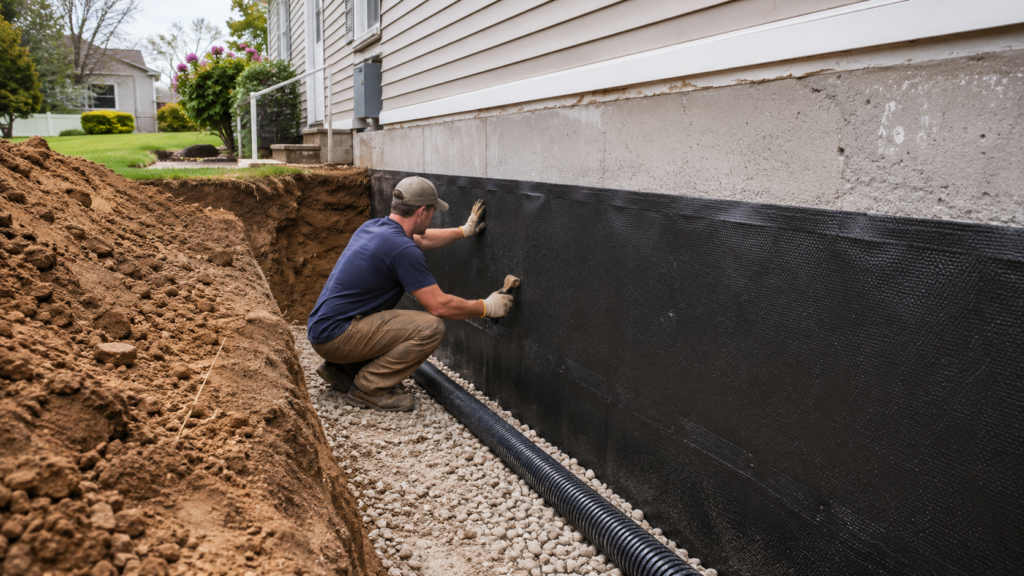
Excavating along the foundation to apply a waterproof membrane, add drainage board and replace footing drains. This is the most complete fix when access allows.
Leaking foundation cracks are sealed from inside or outside.
Regrading soil, extending downspouts, and correcting driveways and patios that pitch toward the house. This is often the cheapest fix of all.

Our process
Tom or a family member walks the property, measures, checks drainage and talks through materials and budget.
You get a clear, itemised quote covering excavation, base depth, materials, finish and clean-up. No pressure.
Our own crew excavates, builds the compacted base and installs the surface using quality materials.
We clean up, walk the finished job with you, explain aftercare and stand behind the work.
| Where you see water | Likely cause | Typical fix |
|---|---|---|
| Along the wall-floor joint | Hydrostatic pressure | Interior perimeter drain + sump |
| Running down a crack | Foundation crack | Crack sealing |
| Below a basement window | Window well filling up | Well drain and cover |
| Only near one corner | Downspout or grading problem | Extend downspout, regrade |
| Damp walls, no puddles | Condensation or wicking | Dehumidifier, exterior grading |
Plan with confidence
| Season | What to do |
|---|---|
| Spring | Test the sump and check for leaks after the thaw. |
| Summer | Run a dehumidifier. |
| Fall | Clean gutters and extend downspouts. |
| Winter | Make sure the discharge line can't freeze. |
Reviews
★★★★★
My sister hired Old Irish for cellar stairs and basement wall work. They arrived early, never left until 5 or after, and always cleaned up. They also told her about leakage inside her foundation and did a great job fixing it.
— Connie B., Google review
★★★★★
Last fall the Old Irish Paving crew repaired our front slate porch and our paver walkway and they did a great job! They came back to complete a minor repair and we are very happy. We are considering using them again for another project.
— Kathleen N., Google review
★★★★★
Wow! What an amazing paving & masonry company. This family-owned company is so knowledgeable and professional. The team gave our home such a clean and upgraded look.
— John Q., Google review
FAQ
Usually surface water and saturated soil are pushing water through cracks or the wall-floor joint. Gutters, downspouts and grading are the first things to check.
Exterior waterproofing stops water before it reaches the wall but needs excavation. Interior drainage with a sump pump is less disruptive and very effective at managing water pressure. Many homes benefit from a combination.
If water collects under the slab or at the footing, yes. A sump pump with a battery backup is strongly recommended in New Jersey, where storms can cause power outages.
Yes. We seal leaking cracks and check whether the crack is structural. If it is, see foundation repair.
Not on its own. Paint can’t hold back water pressure. The water needs to be managed with drainage, crack repair and grading.
In New Jersey, yes. Storms that cause flooding often cause power outages too.
Free, no-obligation quote
Tell us about your driveway, patio, steps or masonry project. Tom or a member of the family will call you back promptly to book a free on-site visit and a written quote.
Prefer to talk? (908) 992-2345