
Family-owned paving & masonry contractor serving New Jersey for 30+ years · Licensed & insured
New Jersey paving & masonry contractor
Welcoming front walks, garden paths and side-yard walkways that are level, safe in winter and built to match your home.
Three decades paving NJ properties
Fully licensed NJ contractor
Owner-led, hands-on projects
Written, no-obligation quotes
Overview
Quick answer
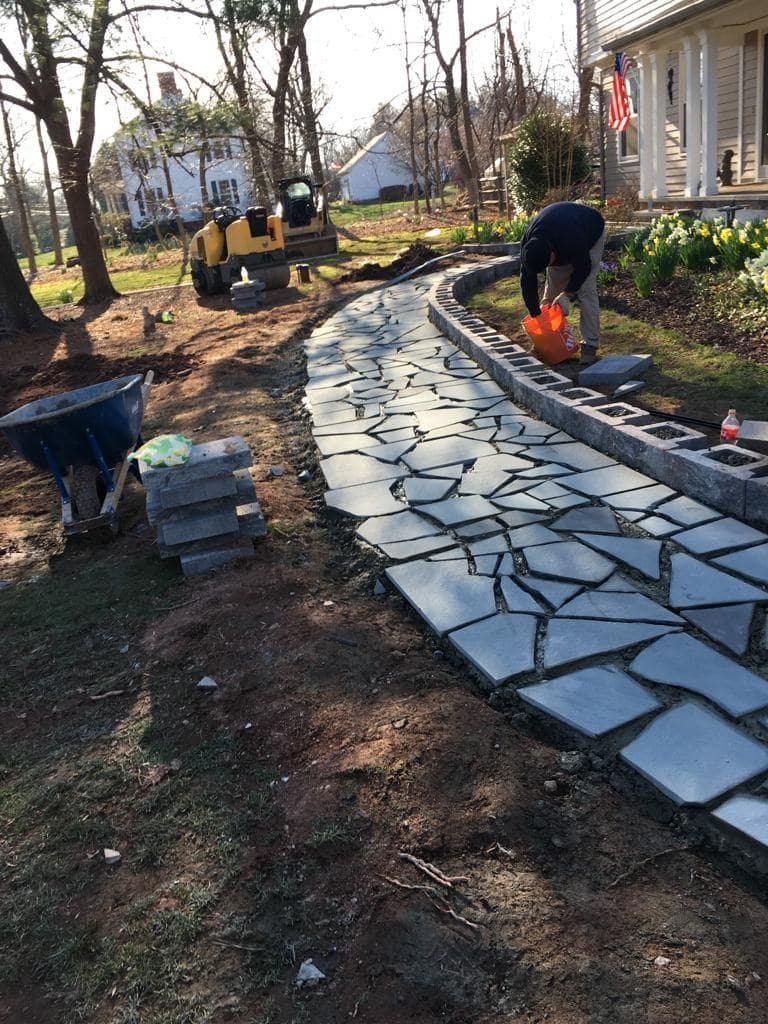
Old Irish Paving & Masonry builds and repairs walkways and garden paths across New Jersey in interlocking pavers, bluestone, brick, natural stone and concrete. Each walkway is set on a compacted base with a slight cross-pitch so water and ice don’t build up, and is tied neatly into driveways, stoops and steps.
Your front walkway guides guests to the door and gets used every single day, often in snow and ice. A good walkway is wide enough for two people (about 4 feet for main entries), has even, slip-resistant surfaces, and transitions smoothly into steps and the driveway.
Key facts
Problems we solve
Most calls we get start with a problem, not a project. Here are the issues New Jersey homeowners and property managers bring to us most often, what causes them, and how we fix them for good.
What you seeEdges stick up, slabs tilt, or pavers have sunk, often near trees or downspouts.
Why it happensTree roots, frost heave, a thin base or water washing out the base.
How we fix itWe remove the affected section, deal with the cause (root barrier or rerouting, downspout extension), rebuild the base and reinstall.
How to prevent itKeep downspouts away from walks and plan walk routes around large trees.
What you seeDips, waves or ruts in a paver driveway, patio or walk, often where cars turn or near downspouts.
Why it happensA base that was too thin, not compacted in lifts, or laid over soft clay without fabric, or too much bedding sand used to level a bad base.
How we fix itWe lift the pavers, remove the bedding and failed base, install and compact new stone in thin lifts (adding geotextile on clay), re-screed and reset the same pavers.
How to prevent itInsist on the right base depth for the use (about 6″ for patios, 8–12″ for driveways) and compaction in 2–3″ lifts.
What you seeWater pools and freezes across the walk, creating a sheet of ice.
Why it happensA flat or back-pitched walk, or meltwater from roofs and snowbanks running across it.
How we fix itWe rebuild with a slight cross-pitch so water sheds off the walk and add drainage where roof runoff lands.
How to prevent itPitch every walk, and don’t pile snow uphill of the walkway.
What you seeGrass and weeds sprouting between pavers, sand piles from ants, and joints washing out.
Why it happensPlain sand in the joints, joints that were never fully filled, or polymeric sand that has worn away.
How we fix itWe clean out the joints, let them dry, sweep in fresh polymeric sand, compact and mist it so it hardens and locks the pavers.
How to prevent itKeep joints topped up, sweep debris off, and consider sealing every few years.
What you seeTwo people can’t walk side by side, and planters crowd the path.
Why it happensMany older walks are only 2–3 ft wide.
How we fix itWe widen main entry walks to about 4 ft and add landings at steps and doors.
How to prevent itTreat the front walk as part of the entrance design, not leftover space.
What you seeGaps opening up between pavers, borders drifting into the lawn, cut pieces loosening.
Why it happensMissing or failed edge restraint. Without it, traffic pushes the paver field outward.
How we fix itWe reset the border on a compacted base and install a proper concrete or spiked edge restraint, then re-tighten and re-sand the field.
How to prevent itEdge restraint is non-negotiable on every paver job. Ask how it will be installed.
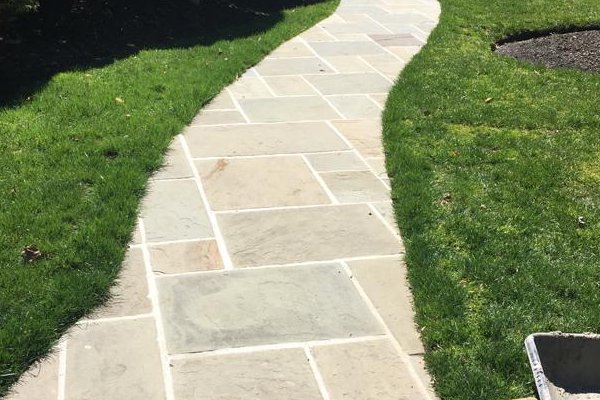
Tripping hazards from heaved pavers, tree roots or settled slabs are common. We reset or replace the affected sections, deal with the cause (roots, drainage, base), and match materials as closely as possible. Pair a new walkway with new stoops and steps for a complete entrance makeover.
Our process
Tom or a family member walks the property, measures, checks drainage and talks through materials and budget.
You get a clear, itemised quote covering excavation, base depth, materials, finish and clean-up. No pressure.
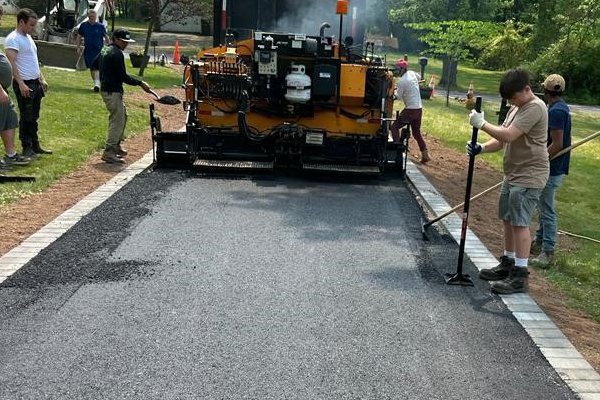
Our own crew excavates, builds the compacted base and installs the surface using quality materials.
We clean up, walk the finished job with you, explain aftercare and stand behind the work.
| Material | Best for | Winter performance |
|---|---|---|
| Pavers | Front walks, matching driveways | Excellent; textured options grip well |
| Bluestone | Classic homes and patios | Good with thermal finish |
| Brick | Colonial and historic homes | Good if on a proper base |
| Concrete | Budget-friendly, simple walks | Avoid harsh de-icers |
| Stepping stones | Garden paths | Casual use |
Plan with confidence
| Season | What to do |
|---|---|
| Spring | Check for heaves. |
| Summer | Re-sand joints. |
| Fall | Clear leaves. |
| Winter | Use gentle de-icers. |
Reviews
★★★★★
I met with the owner Thomas, who gave me ideas and choices for the look I was trying to envision. The crew tore up my old cracked concrete patio and sidewalk and installed gorgeous new pavers. They did the work promptly and professionally and cleaned up well after the jobsite.
— Dawn G., Google review
★★★★★
Last month they did my backyard stoop, patio and walkway, and added a french drain to a sump pit in the yard. They did an amazing job! I highly recommend them for any paving and masonry work. Tom and crew are a pleasure to deal with.
— Bill P., Google review
★★★★★
Tom, his son, and their crew replaced our front walkway and steps and repaired a foundation wall on our home. They were here on time every morning and cleaned up before they left for the day. The quality of their work is outstanding.
— Kate L., Google review
FAQ
We usually recommend about 4 feet for main entrance walks so two people can walk side by side, and about 3 feet for side or garden paths.
Textured pavers and thermal-finish bluestone give good grip. Avoid polished or very smooth surfaces near entries.
Yes. Low-voltage path lights can be planned in during installation.
Tree roots, frost heave, a thin base or water washing out the base. We fix the cause and rebuild the section.
Usually a thin or poorly compacted base, or water undermining it. The fix is to lift the pavers, rebuild the base in compacted lifts and reset them.
Clean the joints and refill with polymeric sand, which hardens when misted. Keep joints topped up and swept.
Usually, yes. Sound pavers are lifted, cleaned and reset on the rebuilt base.
Free, no-obligation quote
Tell us about your driveway, patio, steps or masonry project. Tom or a member of the family will call you back promptly to book a free on-site visit and a written quote.
Prefer to talk? (908) 992-2345