
Family-owned paving & masonry contractor serving New Jersey for 30+ years · Licensed & insured
New Jersey paving & masonry contractor
Custom paver, bluestone and natural stone patios designed around how you relax, cook and entertain, built on a base that stays level.
Three decades paving NJ properties
Fully licensed NJ contractor
Owner-led, hands-on projects
Written, no-obligation quotes
Overview
Quick answer
Old Irish Paving & Masonry designs and builds custom patios across New Jersey using interlocking pavers, bluestone, natural flagstone and concrete. We size and pitch each patio for drainage, build a compacted stone base, and can add steps, seat walls, fire pits, raised planters and pool surrounds.
A well-designed patio extends your living space outdoors. Before we talk about materials, we talk about use: how many people you host, where the grill and table go, where the sun sits in the evening, how you get from the kitchen door to the yard, and where rainwater runs today.
Key facts
Problems we solve
Most calls we get start with a problem, not a project. Here are the issues New Jersey homeowners and property managers bring to us most often, what causes them, and how we fix them for good.
What you seeStones wobble, edges chip, and mortar joints crack and fall out.
Why it happensStone set on a thin or crumbling mortar bed, or a slab beneath that has cracked, with water freezing in the joints.
How we fix itLoose stones are lifted, the bed is cleaned and rebuilt, and stones are reset and repointed. If the slab underneath is broken, it gets rebuilt.
How to prevent itRepoint failing joints before water gets under the stone.
What you seeGrass and weeds sprouting between pavers, sand piles from ants, and joints washing out.
Why it happensPlain sand in the joints, joints that were never fully filled, or polymeric sand that has worn away.
How we fix itWe clean out the joints, let them dry, sweep in fresh polymeric sand, compact and mist it so it hardens and locks the pavers.
How to prevent itKeep joints topped up, sweep debris off, and consider sealing every few years.
What you seeThe table barely fits, chairs fall off the edge, and there’s no room for a grill or fire pit.
Why it happensPatios are often sized to the house or to a budget rather than to how the family actually uses them.
How we fix itWe extend in matching or complementary materials, add a second zone with steps, or redesign with seat walls to add seating without crowding.
How to prevent itSize for use: about 12×12 ft for a six-person dining set, plus room for walking and a grill.
What you seeGaps opening up between pavers, borders drifting into the lawn, cut pieces loosening.
Why it happensMissing or failed edge restraint. Without it, traffic pushes the paver field outward.
How we fix itWe reset the border on a compacted base and install a proper concrete or spiked edge restraint, then re-tighten and re-sand the field.
How to prevent itEdge restraint is non-negotiable on every paver job. Ask how it will be installed.
What you seeCracks, heaved slabs and a dated look.
Why it happensAge, freeze-thaw, roots and a slab poured without a proper base or joints.
How we fix itReplace it with pavers or bluestone on a compacted base, or overlay a structurally sound slab with pavers or stone if door heights allow.
How to prevent itChoose materials that can be repaired piece by piece.
What you seeChalky white film (efflorescence), oil spots, rust marks or dull color.
Why it happensEfflorescence is natural salts migrating out of concrete pavers. Oil and rust come from cars, fertilizer and furniture, and UV fades color over time.
How we fix itWe clean with the correct product for each stain, then optionally apply a sealer to enhance color and make future cleaning easier.
How to prevent itWipe up oil quickly, keep fertilizer off pavers, and seal if you want a richer, easier-to-clean surface.
| Material | Look | Notes |
|---|---|---|
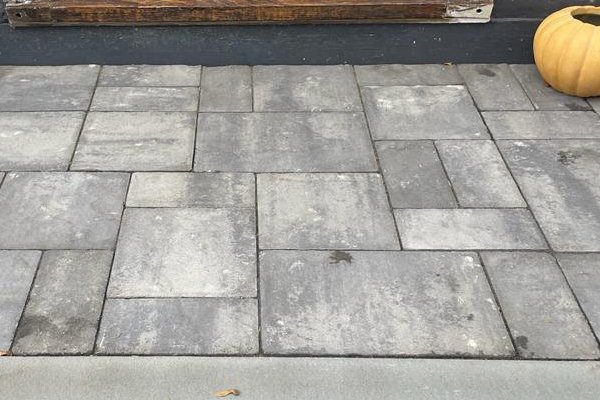
| Interlocking pavers | Endless colors and patterns | Strong, repairable, great for freeze-thaw |
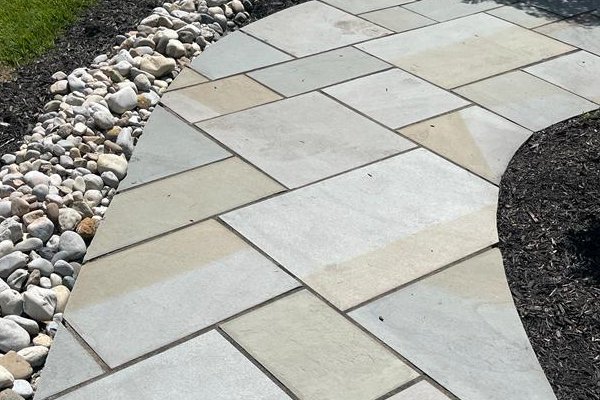
| Bluestone | Classic NJ natural stone, blue-gray | Thermal finish for grip; dry-laid or mortar-set |
| Flagstone / natural stone | Irregular, organic | Ideal for cottage and rustic styles |
| Concrete | Clean and simple | Lower cost; can be stamped or broom-finished |

Our process
Tom or a family member walks the property, measures, checks drainage and talks through materials and budget.
You get a clear, itemised quote covering excavation, base depth, materials, finish and clean-up. No pressure.
Our own crew excavates, builds the compacted base and installs the surface using quality materials.
We clean up, walk the finished job with you, explain aftercare and stand behind the work.
We repair and restore existing patios: resetting sunken pavers, relaying loose flagstones, repointing mortar joints and replacing cracked sections. See patio repair & installation.
Plan with confidence
| Season | What to do |
|---|---|
| Spring | Sweep, refill joints, and check for loose stones or settling. |
| Summer | Enjoy it. Clean grill grease promptly. |
| Fall | Remove leaves and protect furniture. |
| Winter | Avoid metal shovels on stone, and use gentle ice melt. |
Reviews
★★★★★
Old Irish put in a patio for us and we are extremely happy with the patio and their service. They were very responsive and got the job done very quickly. The patio and concrete pad underneath our hot tub look amazing!
— Alyssa M., Google review
★★★★★
My sister hired Old Irish for cellar stairs and basement wall work. They arrived early, never left until 5 or after, and always cleaned up. They also told her about leakage inside her foundation and did a great job fixing it.
— Connie B., Google review
★★★★★
Last fall the Old Irish Paving crew repaired our front slate porch and our paver walkway and they did a great job! They came back to complete a minor repair and we are very happy. We are considering using them again for another project.
— Kathleen N., Google review
FAQ
Most residential patios take 3–7 working days depending on size, materials and features like walls and steps.
It depends on your town. Ground-level patios often don’t need one, but lot-coverage limits, setbacks and walls can trigger zoning review. We’ll check local requirements with you.
Both are excellent. Pavers offer more colors and patterns and are easier to repair. Bluestone gives a classic natural look many NJ homeowners love. We’ll bring samples of both.
Sometimes, if the slab is sound and the height works with your doors. Otherwise we remove it and build a proper base.
The patio was built flat or has settled near the foundation. Rebuilding with a pitch of about 1/8–1/4 inch per foot away from the house fixes it.
Yes. We extend patios in matching or complementary materials, or add a second level with steps or a seat wall.
Usually a thin or poorly compacted base, or water undermining it. The fix is to lift the pavers, rebuild the base in compacted lifts and reset them.
Clean the joints and refill with polymeric sand, which hardens when misted. Keep joints topped up and swept.
Usually, yes. Sound pavers are lifted, cleaned and reset on the rebuilt base.
Free, no-obligation quote
Tell us about your driveway, patio, steps or masonry project. Tom or a member of the family will call you back promptly to book a free on-site visit and a written quote.
Prefer to talk? (908) 992-2345