
Family-owned paving & masonry contractor serving New Jersey for 30+ years · Licensed & insured
New Jersey paving & masonry contractor
Concrete driveways, sidewalks, patios, aprons and equipment pads, poured with mixes and details that stand up to salt and freeze-thaw.
Three decades paving NJ properties
Fully licensed NJ contractor
Owner-led, hands-on projects
Written, no-obligation quotes
Overview
Quick answer
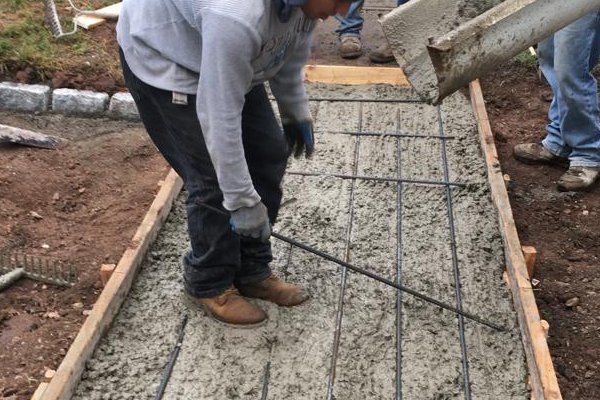
Old Irish Paving & Masonry pours concrete driveways, sidewalks, patios, aprons, curbs and pads across New Jersey. We use air-entrained concrete to resist freeze-thaw damage, reinforcement where needed, a compacted stone base, and properly spaced control joints so cracking happens where it’s meant to.
Concrete gives a clean, bright, durable surface. The details that make it last in our climate are the right mix, a well-compacted base, correct slab thickness, reinforcement, control joints, a good finish, and proper curing. Without them, concrete scales, pops and cracks within a few winters, especially where road salt is tracked in.
Key facts
Problems we solve
Most calls we get start with a problem, not a project. Here are the issues New Jersey homeowners and property managers bring to us most often, what causes them, and how we fix them for good.
What you seeSlabs have dropped at one end, creating a step or a puddle.
Why it happensBase washout, poor compaction or erosion under the slab.
How we fix itWe remove and repour on a compacted base, correcting drainage.
How to prevent itKeep water from running under slabs.
What you seeThe section where the driveway meets the road is cracked, broken or sunk.
Why it happensAprons take the heaviest loads (plows, trucks, turning) and are often thinner than they should be, with poor base at the curb line.
How we fix itWe remove the apron, compact a proper base, and repour thicker reinforced concrete, or install a Belgian block or paver apron that handles loads well.
How to prevent itKeep heavy trucks off the apron edge and make sure your town’s curb and sidewalk specs are followed.
What you seeSmall craters (popouts) or pitting across the surface.
Why it happensPorous aggregate near the surface absorbing water and expanding when frozen, or poor finishing.
How we fix itMinor pitting can be cleaned and sealed. Heavy damage calls for resurfacing or replacement with a better mix.
How to prevent itSeal regularly and avoid harsh de-icers.
What you seeAn open joint where the driveway or walk meets the foundation, letting water toward the basement.
Why it happensSlab settlement or shrinkage, and joint sealant that has failed or was never installed.
How we fix itWe clean out the joint, install backer rod and flexible sealant, and correct slab pitch if water is being directed toward the house.
How to prevent itReseal joints every few years.
What you seeThe top layer of concrete is peeling off in flakes or patches.
Why it happensFreeze-thaw cycles combined with de-icing salts, especially on concrete without air entrainment, or concrete that was overworked or finished with water on top.
How we fix itSmall areas can be resurfaced. Widespread scaling means replacement with air-entrained concrete, proper finishing and curing, then sealing.
How to prevent itNo rock salt or ammonium de-icers in the first winter, and seal every few years.
What you seeCracks wandering across the slab instead of along the joints.
Why it happensControl joints spaced too far apart or cut too shallow, a weak base, or too much water in the mix.
How we fix itSeverely cracked slabs are replaced with a compacted base, correct joint spacing and reinforcement where appropriate.
How to prevent itJoints spaced roughly 2–3 times the slab thickness in feet (e.g. 8–12 ft for a 4″ slab).
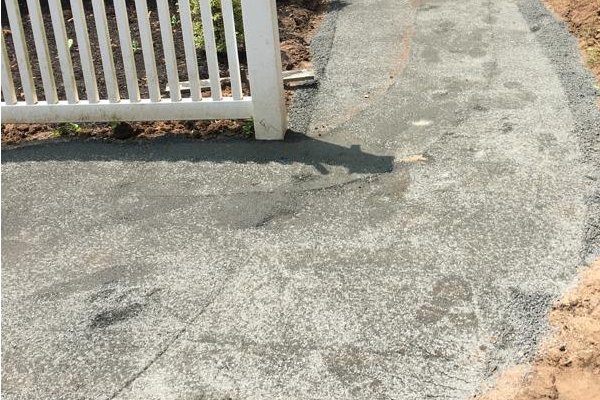
Avoid rock salt and de-icers containing ammonium nitrate or ammonium sulfate on concrete, especially in its first winter. Sand or calcium magnesium acetate is gentler. A penetrating sealer applied after curing and renewed every few years also helps prevent scaling.
Our process
Tom or a family member walks the property, measures, checks drainage and talks through materials and budget.
You get a clear, itemised quote covering excavation, base depth, materials, finish and clean-up. No pressure.
Our own crew excavates, builds the compacted base and installs the surface using quality materials.
We clean up, walk the finished job with you, explain aftercare and stand behind the work.
| Project | Concrete is a great choice when… | Consider instead… |
|---|---|---|
| Driveway | You want a smooth, bright surface and have a flat lot | Asphalt for long or steep drives, pavers for premium looks |
| Walkway | You want a simple, clean, budget-friendly walk | Pavers or bluestone for more character |
| Patio | You want a large, low-maintenance slab or stamped pattern | Pavers or bluestone for easy repair |
| Equipment pad | You need a level, strong base for AC, generator or hot tub | Concrete is usually best |
Plan with confidence
| Season | What to do |
|---|---|
| Spring | Rinse salt off. |
| Summer | Seal every few years. |
| Fall | Seal before winter. |
| Winter | Use gentle de-icers. |
Reviews
★★★★★
I couldn't be happier with the work Old Irish Paving did on my driveway! The team was professional, efficient, and the quality of their work is outstanding. They made the whole process stress-free from start to finish.
— Angel G., Google review
★★★★★
Old Irish put in a patio for us and we are extremely happy with the patio and their service. They were very responsive and got the job done very quickly. The patio and concrete pad underneath our hot tub look amazing!
— Alyssa M., Google review
★★★★★
My sister hired Old Irish for cellar stairs and basement wall work. They arrived early, never left until 5 or after, and always cleaned up. They also told her about leakage inside her foundation and did a great job fixing it.
— Connie B., Google review
FAQ
Usually about 7 days for passenger cars, and longer for heavy vehicles. You can walk on it in 1–2 days.
Concrete shrinks as it cures and moves with temperature. Control joints are cut so cracks form in straight lines at the joints. Random cracks usually mean poor base, missing joints or too much water in the mix.
Concrete costs more and needs more care with salt but lasts a long time with a clean look. Asphalt is more affordable and easier to repair. See asphalt vs. concrete vs. pavers.
Surface scaling is caused by freeze-thaw and de-icing salts, especially on non-air-entrained concrete. Avoid rock salt and seal concrete every few years.
Free, no-obligation quote
Tell us about your driveway, patio, steps or masonry project. Tom or a member of the family will call you back promptly to book a free on-site visit and a written quote.
Prefer to talk? (908) 992-2345