
Family-owned paving & masonry contractor serving New Jersey for 30+ years · Licensed & insured
New Jersey paving & masonry contractor
A family-owned asphalt crew with 30+ years in New Jersey. Here’s how we build pavement that lasts, and what to check before you hire any paving contractor.
Three decades paving NJ properties
Fully licensed NJ contractor
Owner-led, hands-on projects
Written, no-obligation quotes
Overview
Quick answer
A good asphalt paving contractor in New Jersey gives you a written quote that spells out excavation depth, base material and depth, asphalt thickness, drainage and clean-up, and carries insurance and an NJ Home Improvement Contractor registration. Old Irish Paving & Masonry is a licensed, insured, family-owned contractor with more than 30 years of paving experience.
Paving is a big investment, and once the asphalt is down you can’t see what’s underneath it. That’s why the contractor you choose matters more than the surface you choose. Door-to-door crews offering “leftover asphalt” deals are a well-known problem in New Jersey. They typically lay a thin layer over unprepared ground, and it starts failing within a season or two.
Old Irish Paving & Masonry is the opposite. Most of our work comes from referrals and repeat customers, our own crew does the work, and we put every detail of the job in writing.
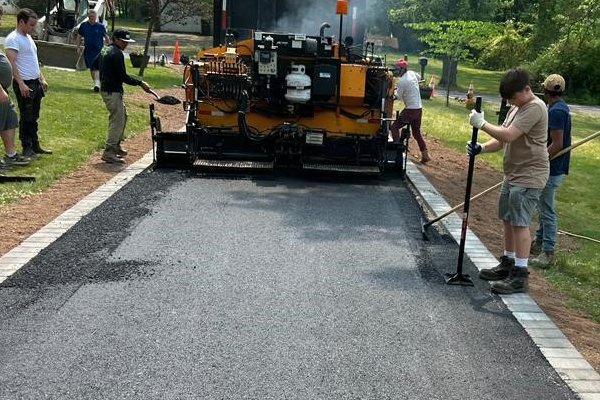
Key facts
Problems we solve
Most calls we get start with a problem, not a project. Here are the issues New Jersey homeowners and property managers bring to us most often, what causes them, and how we fix them for good.
What you seeWater ponds near the garage door, along the edges or in tire ruts long after the rain stops.
Why it happensThe driveway was graded flat or sloped the wrong way, or the base has settled in spots. Standing water seeps into cracks and accelerates every other kind of damage.
How we fix itSmall birdbaths can sometimes be corrected with an infrared or hot-mix leveling patch. Where the overall pitch is wrong, the surface has to come out so the base can be regraded, sometimes with a trench drain or dry well added.
How to prevent itPitch matters most at installation. Ask any contractor exactly where water will go before they pave.
What you seeSlabs have cracked, lifted at the joints, or the surface is flaking off in patches.
Why it happensFreeze-thaw, road salt, tree roots, a weak base or concrete poured without air entrainment and proper control joints.
How we fix itIsolated slabs can be removed and repoured. If the whole driveway is scaling or heaving, replacing it with new concrete, asphalt or pavers on a properly built base is the lasting fix.
How to prevent itAvoid rock salt and ammonium-based de-icers, and seal concrete every few years.
What you seeThe sides of the driveway are breaking off into the lawn, especially where cars drive close to the edge.
Why it happensAsphalt edges with no support underneath, or with base that stops short of the edge, crack under tire loads. Lawn sprinklers and runoff wash out the soil beside them.
How we fix itWe cut back to solid asphalt, extend and compact the base beyond the paved edge, repave, and often install Belgian block curbing to lock the edge in place.
How to prevent itBuild the base wider than the asphalt, tamp the edges at a bevel, and keep heavy vehicles off the outer foot of the driveway.
What you seeA lip has formed at the apron, the sidewalk or the garage slab.
Why it happensDifferent materials settle at different rates, and tree roots and frost lift edges.
How we fix itWe remove and rebuild the transition with a compacted base. At the street we can install a Belgian block or paver apron that ages well.
How to prevent itMake transitions part of the original design rather than an afterthought.
What you seeThe driveway has turned light gray, the stones are showing, and it feels rough underfoot.
Why it happensSun (UV), water and road salt oxidize the asphalt binder over time, making the surface brittle and porous.
How we fix itIf the surface is structurally sound, we fill cracks and sealcoat to restore color and protection. If the stone is coming loose (raveling), a 1.5–2″ overlay renews the surface.
How to prevent itSealcoat every 2–3 years starting 6–12 months after paving, and don’t over-seal yearly, which can cause peeling.
What you seeChunks of asphalt are pushed onto the lawn every winter, and the edges get rougher each year.
Why it happensUnsupported asphalt edges, and plow blades set too low.
How we fix itWe rebuild the edges on a wider base and install Belgian block curbing as a solid, plow-resistant border.
How to prevent itMark the edges with stakes before winter and ask your plow service to use a shoe or rubber edge.

Be careful with anyone who knocks on your door saying they have asphalt left over from a nearby job, pushes you to decide on the spot, wants cash up front, or won’t give a written contract with their registration number. These crews usually spray a light coat over your existing surface or unprepared soil, and it fails quickly. A legitimate contractor will give you a written estimate and time to decide.
Our process
Tom or a family member walks the property, measures, checks drainage and talks through materials and budget.
You get a clear, itemised quote covering excavation, base depth, materials, finish and clean-up. No pressure.
Our own crew excavates, builds the compacted base and installs the surface using quality materials.
We clean up, walk the finished job with you, explain aftercare and stand behind the work.
See what customers say on our reviews page or browse the project gallery.
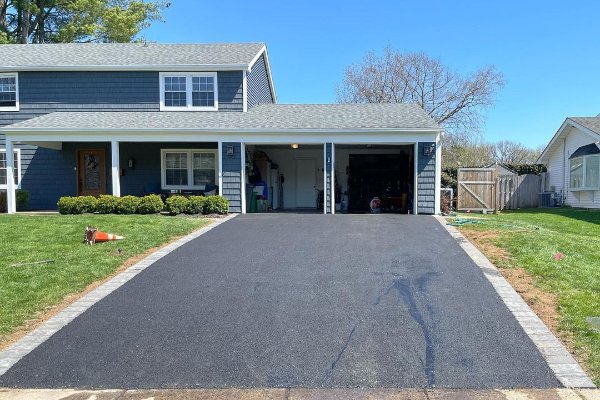
We handle blacktop driveways, driveway replacement and widening, private roads and long lanes, parking lot paving, milling and overlays, crack filling, patching and sealcoating, and asphalt walkways and paths. For businesses we can schedule work in phases to keep entrances open.
Plan with confidence
| Season | What to do |
|---|---|
| Spring | Walk the driveway after the thaw. Note new cracks, potholes and puddles, and rinse off winter salt. |
| Summer | Best time for crack sealing, patching and sealcoating (dry days above 50°F). |
| Fall | Last chance for hot-mix repairs before the plants close. Clean out drains and gutters. |
| Winter | Use a plow shoe or rubber edge, avoid metal shovel edges, and use calcium chloride sparingly. |
Reviews
★★★★★
Tom, his son, and their crew replaced our front walkway and steps and repaired a foundation wall on our home. They were here on time every morning and cleaned up before they left for the day. The quality of their work is outstanding.
— Kate L., Google review
★★★★★
I couldn't be happier with the work Old Irish Paving did on my driveway! The team was professional, efficient, and the quality of their work is outstanding. They made the whole process stress-free from start to finish.
— Angel G., Google review
★★★★★
Old Irish put in a patio for us and we are extremely happy with the patio and their service. They were very responsive and got the job done very quickly. The patio and concrete pad underneath our hot tub look amazing!
— Alyssa M., Google review
FAQ
Excavation depth, removal and disposal of the old surface, base material and compacted depth, asphalt mix and compacted thickness, drainage/pitch, edging, clean-up, payment schedule, start window and the contractor’s NJ registration number.
Usually, yes. Legitimate contractors order asphalt for each job. “Leftover asphalt” offers are a common door-to-door scheme that ends in a thin, failing surface.
Our own crew does the paving and masonry work, and the owner stays involved from estimate to completion.
It depends on the season and the asphalt plants’ schedules. Spring and fall book up fastest, so call (908) 992-2345 early and we’ll give you a realistic start window with your quote.
Financing may be available for qualifying projects. See our financing page or ask during your estimate.
Most recurring cracks come from water getting into the base, not from the asphalt itself. Seal cracks while they’re small, fix drainage, and if alligator cracking has spread, rebuild the base in that area.
No. Bagged cold patch is a temporary fix. A permanent repair is saw-cut, excavated, rebuilt with compacted stone and filled with hot-mix asphalt.
No. Every 2–3 years is right for most driveways. Sealing too often builds up a film that can crack and peel.
Regrade the driveway so it pitches away from the garage, or install a trench drain across the driveway in front of the door, piped to a dry well or daylight.
You can, but it rarely looks or performs right next to asphalt or pavers, and many towns limit driveway width. A paved widening on a matching base is the lasting fix.
Free, no-obligation quote
Tell us about your driveway, patio, steps or masonry project. Tom or a member of the family will call you back promptly to book a free on-site visit and a written quote.
Prefer to talk? (908) 992-2345